There is something fascinating to me in the process of image fidelity, compression, loss, and the vagueness you can achieve by running something through processes, either analogue or digital. This often applies to video images, as evidenced in some experiments I filmed a few years ago that can be viewed here. The inspiration for the video came in a few different layers.
First of all, it was opportunistic because of the weather. Will (the girl in the video) and I were living in Sale in close proximity to Sale Water Park, which is a regular photo/video haunt of mine, and the weather turned very cold and there had been heavy snow. I thought it would be a great and rare opportunity to film in these kinds of conditions, and so we went out and braved the weather to see what kind of interesting shots we could get. There was no sense of a narrative structure that I wanted to create, and beyond creating an interesting collage of moving images I had no particular agenda, hoping simply instead to just gather more material for later use. As we were out, the snow began again and proceeded to get heavier and heavier. I had some sense of inspiration for mood, or tone at least, and so we improvised some very basic sequences. Will was a trooper and did very well considering there was no narrative to follow, and she was very cold (she doesn't like being cold). All in all we used only about half of the footage in the above video, and all of it was from later on in the filming session. This is something I've noticed quite often when I attempt improvisational work like this, in that it takes some time to get flowing creatively and for the interesting material to be generated, with a lot of the early work being somewhat formless and not very relevant. I used a tripod in these early shots, but in the final edit most of the shots ended up being handheld. The camera itself was not new or particularly modern and although it has quite a decent set of features, the image fidelity is relatively low. It uses hard drive storage or SSD memory, rather than tape, and is fairly low resolution, making it a handy camera but not suitable for a lot of things, however it is this lack of fidelity that proves essential later.
I had cut together a video in a few hours using Adobe Premier (a horribly unstable piece of crap) and tweaked colours and tones in various ways to produce an interesting end product. There was a level of texture I felt was missing, however, and some time later (how long I am not sure at the moment, possibly months, maybe just days) I decided to try an experiment, inspired by this trailer for video game Silent Hill 4: The Room, which I found to be deeply provocative and interesting and is the video that had me hooked on the entire series, when before it was completely obscure to me. The trailer had a distinct 'VHS' feel to it, and it would appear that footage of the game (which is largely lacking in menus or displays during gameplay, leaving the player with simply the image of the game environment and characters) was filmed on a handheld camera, which transforms the often clunky graphics of the game (I was definitely a bit disappointed when I actually played it, because the level of detail in parts was certainly not as good as it could have been) into something very organic, very real. It becomes flesh in the video in a way that wasn't quite there in the game itself. Ultimately the trailer is simply a collection of images and doesn't have narration or attempt to relay the game's story in any meaningful way, like a trailer normally would. Also, the trailer is exceptionally long for the format, making it something more of an art-house film than a marketing product. It is an entity all unto itself and I keep finding myself coming back to it as a source of inspiration. I was also influenced by Shinya Tsukamoto's A Snake of June, previously discussed, in that it is filmed in black and white but there is a blue tone overlaying it, giving it a distinct, maybe slightly perverted feel, that really permeates everything within the film.
I filmed a playback of the video I made on my computer screen, and then ran this through Adobe Premier again, applying more effects and also making attempts at creating an abstract soundtrack on a number of occasions, eventually settling on a piece I made using Fruity Loops (primarily used for sequencing electronic music, but a powerful tool for recording and editing music or samples also), using samples of animals slowed down and mixed with various effects, with some layered synths. I removed all colour from the footage, and then applied a similar blue hue to 'wrap' the video, resulting in some very good effects. I showed Ian this video on my laptop (sadly my laptop speakers are rubbish and the soundtrack was inaudible) and he described it as "disturbing", which I took as a compliment. As an experiment, it is one of my most successful pieces so far.
See also a short video I improvised with a friend of mine, Dom. We did not record usable audio, with a mind to maybe adding it later, but this never came about as I hadn't planned that element enough in advance, and so it became quite a problem to implement. The video was meant to be simply an exercise, and fun, and from start to finish took about 25 minutes to produce, with around 2 hours time editing. It could be considered a silent film, I suppose. You can clearly see how much fun Dom is having in this video. I had a lot of fun as well. Evil Dead 2: Dead By Dawn is definitely an influence on this piece. It is one of my favourite films. Comedy and horror can be one of the most successful combinations.
"How To Haunt Yourself"
Showing posts with label reference material. Show all posts
Showing posts with label reference material. Show all posts
29 Sept 2011
25 Sept 2011
Shinya Tsukamoto
The following images are taken from promotional material for the film Tetsuo: The Bullet Man (2009), the third film in the series by Shinya Tsukamoto, who is a personal favourite of mine from since I was a child. I first saw Tetsuo II: Body Hammer (1991) in the mid-nineties, when I would have been around ten years old, after my older brother had taped it from television. The plot follows a man who is pursued by mysterious thugs subscribing to a kind of metal fetishism, who seek to draw out a violent transformational physical response from the man, in which weapons, namely guns or cannons, emerge from his body. Through their actions, the man accidentally kills his own young son in an uncontrollable fit of rage, aimed at the men who kidnap him. Throughout the film, he goes to and from a state of physical transformation, somewhat reminiscent perhaps of a cross of Cronenberg's The Fly and Cameron's The Terminator, becoming entirely lethal and completely out of control. By the films conclusion, he is essentially a tank rolling through Tokyo with no intention in mind other than destruction.
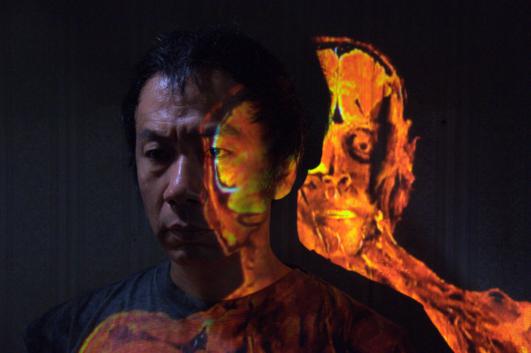
The third film in the series is essentially a more modernised reworking of the story of the second film, with some more of the art-house influences present in the 1989 Tetsuo: The Iron Man. The visual effects are refined and the 'Tetsuo' design is more complex visually, and the film itself has a considerably higher fidelity than the grainy film used in the original two films. However, by transitioning to digital film, there is a quality in the original films that is lost, namely the dirty roughness reminiscent of rust, a theme very significant to the first two films. The Bullet Man is a more chaotic affair than Body Hammer but lacks of the black humour of The Iron Man, resulting in a film that is less certain of itself perhaps than it's predecessors.
Tsukamoto's work is often concerned with transformation or the transformational effect of emotions, often rage, on a person. Tokyo Fist (1995) is similarly concerned with anger and violence, infused with a great deal of the black humour present in the first Tetsuo film. In A Snake of June (2002), the main themes are voyeurism and malaise, with the main character a woman in an interminable marriage that is completely sexually repressed, who inadvertently inspires a photographer to 'save her' the way she saved him through a sort of Samaritans hotline. He does this by blackmailing her into exploring her sexuality, threatening to send on photographs of her masturbating to her husband if she doesn't comply.
Tsukamoto stars in all of these films, and would typically be considered an auteur as he writes and directs most of his work, occasionally taking direction only projects. This would indicate that these roles that he plays (the antagonist in all three Tetsuo films, the photographer in A Snake of June and the anti-hero in Tokyo Fist) have great significance to him.




The third film in the series is essentially a more modernised reworking of the story of the second film, with some more of the art-house influences present in the 1989 Tetsuo: The Iron Man. The visual effects are refined and the 'Tetsuo' design is more complex visually, and the film itself has a considerably higher fidelity than the grainy film used in the original two films. However, by transitioning to digital film, there is a quality in the original films that is lost, namely the dirty roughness reminiscent of rust, a theme very significant to the first two films. The Bullet Man is a more chaotic affair than Body Hammer but lacks of the black humour of The Iron Man, resulting in a film that is less certain of itself perhaps than it's predecessors.
Tsukamoto's work is often concerned with transformation or the transformational effect of emotions, often rage, on a person. Tokyo Fist (1995) is similarly concerned with anger and violence, infused with a great deal of the black humour present in the first Tetsuo film. In A Snake of June (2002), the main themes are voyeurism and malaise, with the main character a woman in an interminable marriage that is completely sexually repressed, who inadvertently inspires a photographer to 'save her' the way she saved him through a sort of Samaritans hotline. He does this by blackmailing her into exploring her sexuality, threatening to send on photographs of her masturbating to her husband if she doesn't comply.
Tsukamoto stars in all of these films, and would typically be considered an auteur as he writes and directs most of his work, occasionally taking direction only projects. This would indicate that these roles that he plays (the antagonist in all three Tetsuo films, the photographer in A Snake of June and the anti-hero in Tokyo Fist) have great significance to him.


Man-machine physical transformation (American actor Eric Bossick) in Tetsuo: The Bullet Man

Shinya Tsukamoto in Tetsuo: The Bullet Man

Promotional artwork for Tetsuo II: Body Hammer
Promotional artwork for Tetsuo: The Bullet Man


Luigi Russolo - The Revolt (1911)
This work reminds me of some of the things I did for the summer project and also in the recent fine art sketch exercises in the last week. The colours are very vibrant, however, which resonates the idea of revolt, or revolution, upheaval. It is aggressive, even violent. With what appear to be shapes of buildings surrounding it, the combination conjures impressions of a city on fire.


Subscribe to:
Posts (Atom)