Showing posts with label Life drawing. Show all posts

17 Nov 2011

Egon Schiele


EGON SCHIELE

Egon Schiele was an Austrian born artist, trained under Gustav Klimt, who primarily focussed on portraits and who produced a great deal of self-portraits. He is well known for his unique approach to fthe figure, in particular his exaggerations of features and thematic obsessions with sex and death. At times his works were graphic and in early 1900's Austria he faced censure over the sexually explicit nature of his paintings, and was briefly imprisoned for having explicit worrks in his studio that could be visible to children. Infamously, one of his drawings was burned in front of Schiele by the judge of the trial. Despite this, Schiele found success towards the end of the First World War in a period in which he is considered to have been in his prime as an artist. The brutality of the war is reflected in his uncomfortable, jarring style of physical representation.

Schiele died aged 28 during the Spanish flu pandemic in October 1918. Though he died young, he was a prolific artist and produced hundreds of works that have come to be widely studied. His unconventional approach to portraiture is significant in it's contrast to more traditional styles of the time, and has been influential since.

The origins of Schieles very stylised approach to representing the figure are likely influenced by his obsessions with physical vulnerability, morbidity, sex, and the combinations of all of these facets. His characters, and particularly in his self portraits, are distorted, skeletal and look physically broken or sickly. Not all of his works are as extreme, however, and some of his works, though recognisably his, do not contain the physical pain present in his self portraits. It would appear that with these pieces especially there is a sense of body dysmorphia, as present in the sef portraits by Jenny Saville and other artists who are uncomfortable with their own self-image.

Schiele's use of colour is a key element of his 'sickly' style, painting flesh tones in off yellows, and creating bizarre skin contours and textures, emphasising and exaggering wrinkles, skin folds, muscle and bone structure.


16 Nov 2011

Life drawing


9TH SESSION – 16/11

After last weeks focus on heads, hands and feet, we returned to full figure drawing, but with a significant change in the models posture, to fully reclining on the floor as opposed to sitting or standing, which up until this point had been the only variety of basic poses we had been using. The change in posture provided us with new challenges in approaching the figure, as a lot of the standard rules about interpreting the figure were no longer 'true' as such. Measurement and awareness of bone structure became particularly important.

We began the session with four short warmup sketches in different styles and media; a fast gestural sketch with straight lines, a continuous line drawing followed by another, but with our other hand, and finally an unusual but very interesting method, which involved standing alongside the easel in such a way that we could not see our drawing, and we could only see the model, effectively drawing 'blind' in a sense. This produced some very interesting results. Though it was not specified that it be another continuous line drawing, I found that due to the nature of working without vision on the piece, the only way to judge where I was on the paper was to not remove my hand from it, akin to feeling along a wall in the dark when searching for a lightswitch.

I found that the added difficulty resulted in it taking considerably longer to have the basic geometry and lines of the drawing in correct proportions and in the right positions, leading me to unfortunately neglect the details of the head and hands on both main works, due to time constraints. I observed that I was not the only person with this issue, as several people noted during the critical discussion at the end of the session that they could have continued on drawing for considerably longer still. Another issue I found that was not so much caused by the reclining position but definitely aggravated was that due to the added challenge of interpreting the figure in that position, proportions expaned and contracted multiple times during the basic geometry stage of the second drawing and this resulted in the top of the head and the majority of the feet being left off the page. Although I do feel my scaling of my drawings is definitely improving, it clearly still needs more work.

 Due to the issue with the time constraints, i found that I had to rush to apply tone to both drawings, but because I consciously decided to change from correcting the line aspect of the drawing to tone, I gave myself adequate time to complete this part of the drawing, though not enough time to refine it necessarily. As a result, though, I am actually quite satisfied with the tonal work on these drawings, as they are more 'complete' than they have often been in the past, again due to running out of time and not effectively managing the time given to us.

Four warmup sketches; gestural sketch, continuous line drawings and the 'blind' drawing, the most interesting of them all.


Drawing 1; proportionally good, facial details are left out largely due to the unexpected difficulties in drawing the face from such a peculiar angle. I tried to apply the typical rules of measurement and also placement as learned last week, but kept failing, so due to the lack of time I chose to apply general tone and complete the tone for the rest of the figure. I am pleased with the tonal work here.

Drawing 2: Proportionally more awkward, the geometry kept having to be drastically altered several times, and in the end the overall figure was longer than I had accounted for, leading to cut-off at either end of the figure. The tonal work is satisfactory but I feel that the legs were not really corrected still during the geometry stage, and like before I sacrificed this to some degree in order to get complete tonal coverage, which imrpoves the image overall as a result.


11 Nov 2011

Life Drawing

I missed Wednesdays session so I came in for Friday morning instead, to make it up.

This weeks area is the beginning of observing in more detail, the drawing of heads, hands and feet. These are typically problem areas for many people, myself included, and can offset an otherwise technically accurate drawing with frustratingly clumsy or inarticulate depictions of specific features.

We began by observing the models head first of all. We were advised that the general shape of the head tends to be fairly simple in most instances, and so beginning the drawing of proportions can be reduced to a simple geometric combination. Greg pointed out that when looking at a person, it is usually not just the front of the face that is visible but even the crown of the head. As we were advised, I began my drawings by creating a sketchy circular shape, and then adding lines to represent the jawline in whatever position it was meant to be, adjusting it bit by bit until it started to look reasonably accurate, gradually adding more detail but still keep it relatively rough.

The drawings were quick and simplistic.

Different poses provided different problems but were exciting to experiment with, particularly at speed.

The drawings were good opportunity to practise placement and proportion without  spending a lot of time  on perfecting details at this stage.


The drawings were not particularly of a high quality but provided me with an understanding of what to do in future drawings, and with practise I expect my drawings to improve more rapidly.

This drawing in charcoal uses the notion of negative space and inversion to create variations in tone, in a manner that I found particularly interesting and enjoyable. The charcoal was applied to the paper and rubbed in to create an overall block of tone, onto which areas were added to more thickly for definition, or removed with an eraser for highlights. The effects were subtle and quite dramatic, however the angle at which I was sitting in relation to the model for this pose made it difficult and I would have liked to apply this technique on a larger drawing containing more of the figure.
Drawing hands & feet is definitely a challenge in terms of adding detail, however the outline is reasonably straightforward to accomplish, particularly when working gesturally.

2 Nov 2011

Life drawing

Today we looked at composition at an experimental level. We began by doing quick test drawings of the model, framing elements and then developing a chosen element into a larger piece of work.

Recently I have had difficulty in drawing, and I believe the issue for me is the medium and my lack of comfort with it, namely working in pencil. I prefer working gesturally and although I could quite comfortably continue working in loose mediums like charcoal, I do feel that I need to improve my skills on a technical, realistic level, and so I have been trying to persevere with pencil work. However, this led to frustration and with the initial drawing attempts that I was making in pencil, the results were unsatisfactory and abortive. As time was running out to complete this stage of the work for the day, I decided I need to have something solid to work with so I quickly went back to doing a quick charcoal drawing, drawing fast and loose and although the results were not as I would have hoped, I felt more prepared to go onto the next stage.

We had a selection of medium available to us to use, and today also marked the beginning of using colour in tone to develop the image. We had the option of using inks for the first time, which I found a very exciting notion, as I felt this could continue in the gestural expressive style that I favour. There were only three shades to use, which created an interesting limitation to work around, and the colours were quite strong so I knew from the outset that the results would be striking at least. We had available to us Prussian blue, crimson (more pink a shade than I expected) and brown, and I spent a good deal of time experimenting with the use of water to thin out and great variations in tone. There is definitely a lot more I would like to do with inks and the piece that I began in the session needs more work, which I aim to continue on with outside of the designated session time before next week.

Top left to right, abortive pencil drawings (second of which I used as a base for a  quick test of the inks before progressing onto canvas), below is the quick 'emergency' charcoal drawing with some of the inks mixed in - resulting in a blotchy mess. Right is a quick sketch in graphite, with inks overlaying - more successful.

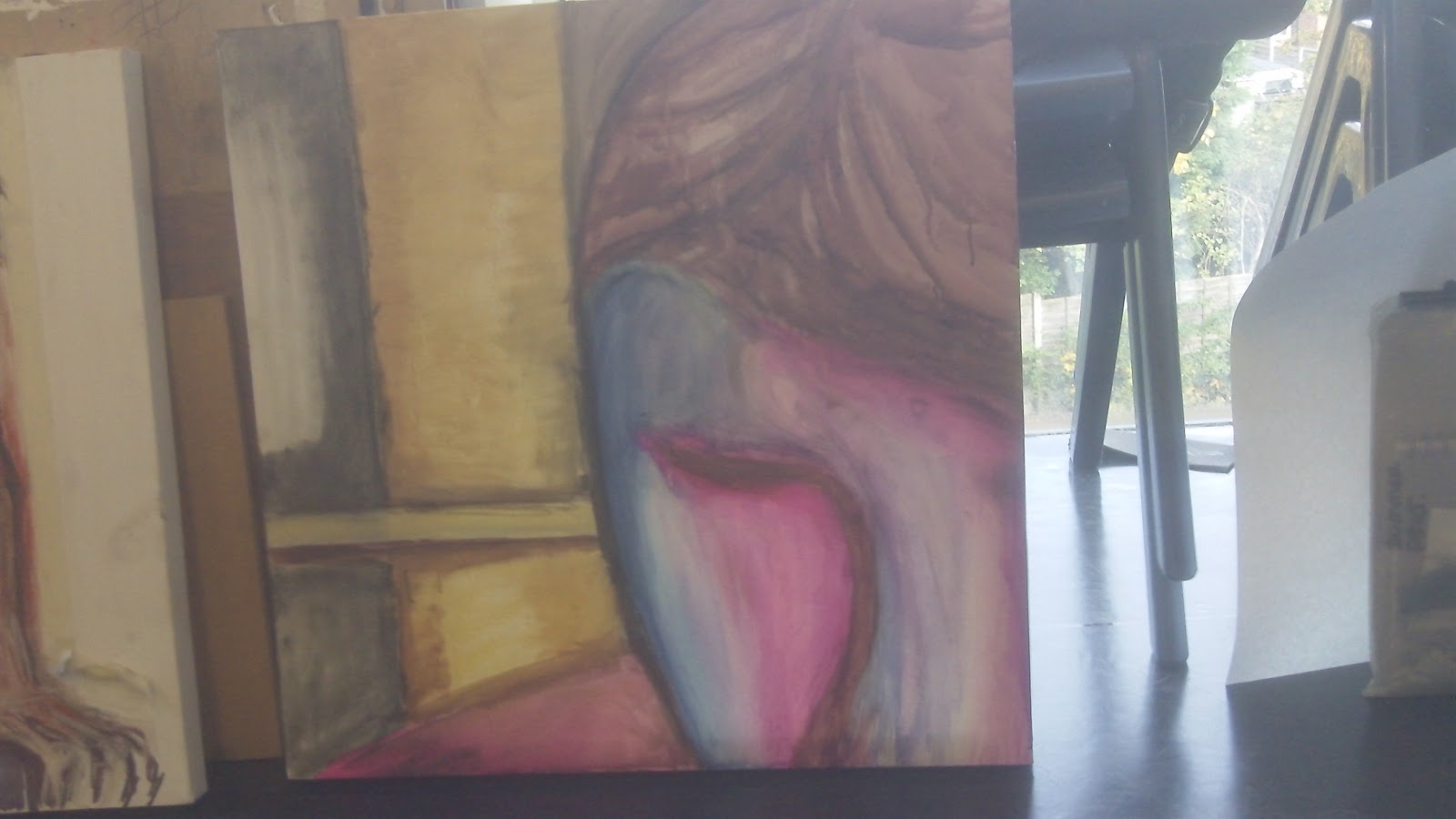
Canvas piece as it exists at the moment, focussing on models face and shoulder. The inks are overworked and need toning down to an extent, and once the piece is to a higher standard I will take a better photograph with my DSLR. Background elements in coloured chalk, mixed with water by hand to experiment in tone (not successful in my view).

19 Oct 2011

Life drawing

Today's session was a little bit frustrating as I have been feeling my limitations in drawing coming to the fore gradually over time as the course progresses. I think the heart of it lies in my lack of practise of measurement, and my impatience. I know that I need to spend the time on the initial stages, and in order to do that I need to relax and become more comfortable with that stage. Working gesturally is my preferred method, and I need to find the harmony between gestural drawing and the more 'academic' notion of measurement.
Effectively unfinished, the lower half of the drawing is underdeveloped, but with attention to detail  increased in the top half of the drawing.

On the positive side however, I spent an inordinate amount of time on this piece working on the area of the face and tone of the skin, and so far it is probably my best rendition of this part of the models anatomy. The drawing still doesn't 'look like' the model as much as I would like, but it's steadily approaching that point.

Quick drawings with an eye to working tone around the shape of the figure, however for me there wasn't enough time available to really develop these drawings as much as I would like. On the whole I do not like these drawings.

More of an attempt at incorporating background into the composition, this is also one of the only drawings so far where I have successfully kept the whole model in frame and also kept proportions reasonably accurate as well. There is a great difficulty in avoiding 'stunting' the image, shortening or widing perspective beyond recognition.

9 Oct 2011

Jenny Saville

Through the first four sessions of life drawing that we have had so far, and from having not done a great deal of figure drawing before the beginning of this course, I have been discovering a great deal about my own inherent leanings in this particular area. The mode that tends to be the most comfortable and expressive for me is with gestural drawing, making strong and loose marks, often repeatedly for emphasis or also to remove emphasis by making things indistinct (there is a balance with this that I am still trying to perfect, as I can often overwork my drawings at this stage). Of the drawings that I have been making, those that I am most interested in after the fact tend to be raw, perhaps aggressive. With hindsight this makes sense to me as this is reflected in a lot of my tastes in other media, notably film and music, be it the bio-mechanical ultra-violence of Shinya Tsukamoto's Tetsuo or the oppressive, claustrophobic sound-scape's of Neurosis' Times of Grace album. There is a link between all these elements for me that goes some way to interpreting how I view the world on a subconscious level.


Jenny Saville's paintings are depictions of the reality of flesh, and more importantly they are direct links to our own complicated feelings about our own bodies, both on a personal level and also as a society. There is distortion through the choices of angles uses to view the figure, distortion through physical contortion in some cases, emphasising the sense of almost fundamental discomfort of existing in the body being portrayed. In the above painting "Strategy (South Face/Front Face/North Face)", the chosen angle is used to highlight and even emphasise the obesity of the figure, further drawn out by the choice of views available, providing the observer with every single detail of that specific facet of the figure. In each segment, the figure is looking directly at the observer, not allowing herself to be dehumanised in the otherwise fairly mechanical manner in which she is being presented.

Although not the most extreme example of Saville's style of painting, this piece does serve well to demonstrate her primary concerns, that of flesh as an agent of life and also death. Her work reeks of mortality in it's various stages, and is strikingly vivid and physical. Interestingly, the 'North' and 'South' segments are comparitively duller in tone compared to the 'Front' segment, which almost glows.


"Continuum" shows more clearly the aggressive nature of flesh that she more commonly presents, her palette emphasises the blood under the skin, particularly in the lips, with the gestural nature of her markings leaving some of the finer details of the figure to the imagination - does the child have a birthmark, or is he merely flushed? There is a suggestion perhaps of physical trauma, or at least a heightened state of emotion.


Jenny Saville's own self-portraits are particularly revealing as to her rationale for her work in general. Again her usual motifs of the significance of flesh, of curves and weight, are prevalent, this time with additional neuroses regarding her own issues with her body. She has drawn lines on her own body, reminiscent of contours of a landscape as you would find on a topographic map, and also similar to the lines used by plastic surgeons when marking out their incisions. Saville spent some time early in her career observing plastic surgeons at work, and this again only highlights the significance of body dysmorphia as a central theme. There are complicated feelings being demonstrated regarding her own body, and she is confronting that in all of her work by examining the bodies of others, alive and dead, human and animal, and in her most interesting work, managing to create a sense of a juxtaposition of all four states at once.


5 Oct 2011

Life drawing notes

We expanded upon our techniques learned last week, namely monocular measurement and introducing the concept of axis in the figure. We did three warm up drawings this time, on one sheet - I found these came together quite well, but this was no doubt aided by the fact I had a proper pencil to use this time, along with a purple pencil for marking out the geometry.

We went on to do one major drawing for the rest of the session, with one pose. I struggled in parts, finding myself overworking elements of the drawing which made it more difficult. To counter this, I decided to use extra space on the paper to focus on a smaller scale on some of the other parts of the figure, namely the head/top half of the torso, the left leg and foot, and left hand, as these were all parts that were either messy in my opinion, or had been otherwise neglected.

At this point it is becoming clear that my work is, at this stage but probably in a more fundamental way also, quite gestural and expressionistic, as opposed to being strictly precise. In the self-portrait sketches I have done in the last few days I have found my drawings 'coming together' more comfortably in this manner, as quick gestural drawings, and I am looking forward to transferring this to paint and other mediums in the future.

28 Sept 2011

Life drawing journal notes


Today we covered monocular drawing, with the aim of improving and perfecting proportion, accuracy and the relationships of parts to one another. This was more challenging in many ways than the more freehand, expressive way that we are all more accustomed to, and everybody found this to be fairly difficult. Some people found it to be more rewarding than others, and personally I found that after a while, this method did indeed help bring things to a better level. I do still have an issue with framing, keeping the entire ‘image’ within the boundaries of the paper, but this was improved today over previous drawings in the past few weeks. I found I made things a bit more diffiocult also because I had forgotten to bring my own pencil supply, meaning i had to use whatever was available, in this case an orange pencil. If I had a second colkour, oor a proper pencil or graphite stick, I couold have nforced some of the lines and this would have improved the clarity of the drawing.

21 Sept 2011

Life drawings


Similarly to last week, we began with quick exercises lasting a few minutes each, before moving on to new techniques. We were asked to try continuous line drawing, and then to try this with our ‘other’ hand, in my case my left hand. The purpose of this was to free ourselves from concerns of quality, fully expecting that these drawings would be technically inferior, but possibly more abstract and interesting because of the removal of the traditional means of approaching drawing.

These ideas were continued on into later drawings, but not as an absolute rule - we were able to pick which elements we wanted to draw from, with continuous line drawing as a starting point.

I had previously been avoiding using graphite as I did not find it allowed me the freedom of range that charcoal provides, however I decided to persevere and attempt to incorporate it. I found very quickly that graphite was very effective for drawing out early definition of shapes very lightly, allowing me to experiment before committing with charcoal in a more severe manner. I did find however that white chalk does not go over graphite very well at all and so I was thwarted when I tried to blend white chalk in with the graphite and charcoal, in the way I had mixed the previous week.


Posted by Picasa

14 Sept 2011

Life drawings


First sketches were quick 1 or 2 minute exercises, covering multiple poses on individual sheets. Detail not a factor - simply intended as a warmup. We moved onto increasingly longer exercises, added tone and detail over time. The last piece of work was set to take around 45-50 minutes.

At the end of the 3 hours, everyone picked out their preferred piece of work from the morning and all of these were lined up for quick analysis and comments from each student


Posted by Picasa